Julio-Claudian Dynasty
five reigns XXVII BC — LXVIII ADThe founding dynasty of the imperial system, descended from Julius Caesar through his great-nephew Augustus and, by marriage, through the patrician Claudii. Five reigns across ninety-five years. It produced the longest tenure in Roman history, the most concentrated act of administrative design ever undertaken by a single man, and the strangest sequence of personalities ever to hold absolute power: a triumvir turned prince, a brooding recluse at Capri, a theatrical god-king, a limping scholar who conquered Britain, and an emperor-actor who fiddled with his lyre while the city burned. The line ended in the summer of 68, by Nero's own hand, on the blade of a freedman who did not want the job.


Year of the Four Emperors
three pretenders LXVIII — LXIX ADThe eighteen months between Nero's suicide and Vespasian's consolidation revealed, as Tacitus wrote, the secret of empire: that an emperor could be made elsewhere than at Rome. Three legionary commanders raised their legions, marched on the capital, and were destroyed in turn. Galba came from Spain and reigned for seven months. Otho came from Rome itself, held power for three months, and killed himself at Bedriacum. Vitellius, the glutton of the Rhine, lasted eight months before the Danube legions tore him to pieces in the street. Four emperors in a single year, a rehearsal for the third-century catastrophe that lay two centuries ahead.


Flavian Dynasty
three reigns LXIX — XCVI ADRisen from the Judaean campaigns and the chaos of the four emperors, the Flavians were Rome's first non-patrician dynasty, a family of Sabine tax collectors who restored the treasury, leveled the ruins of the Great Fire, and built the Colosseum on the drained lake of Nero's Golden House. Vespasian steadied the state with dry peasant humor. Titus, his elder son, governed the Jewish War, presided over the eruption of Vesuvius, and died young and mourned. Domitian, the younger, ruled fifteen efficient and brutal years before the conspiracy of his own household left his body on the floor of the palace. With him, the second dynasty ended, and the Senate voted his name stricken from every inscription in the empire.


Nerva-Antonine Dynasty
seven reigns XCVI — CXCII ADThe age Gibbon called "the period in the history of the world during which the condition of the human race was most happy and prosperous." Five emperors chosen not by blood but by adoption, each succeeding a man who had selected him for the work: Nerva, an old senator chosen to heal the state; Trajan, the Spanish soldier who carried Roman standards deepest into Dacia and Parthia; Hadrian, the philhellene who walked every frontier from Britain to the Euphrates; Antoninus, whose long, unremembered reign is the historian's cliché for contentment; and Marcus Aurelius, who wrote the Meditations in his tent on the Danube. The pattern broke with Commodus, the dynasty's only biological heir, who preferred the arena to the Senate and ended strangled in his bath on New Year's Eve of 192.


"Omnium consensu capax imperii, nisi imperasset."
By general agreement a man capable of rule, had he never ruled. — Tacitus, on Galba. An epitaph for more than half of what follows.
Year of the Five Emperors & Severan Dynasty
eight reigns CXCIII — CCXXXV ADWith Commodus dead, the Praetorians sold the throne to the highest bidder. Within a year Septimius Severus, an African jurist-general from Leptis Magna, was master of Rome. His dynasty lasted forty-two years and ruled through pure military power: he told his sons on his deathbed to enrich the soldiers and despise the rest. Caracalla made every free man in the empire a citizen and then murdered his brother in their mother's arms. Elagabalus installed a Syrian sun-god in the Palatine and was killed by his own guard at eighteen. Severus Alexander, the last of the line, died in his mother's arms at the Rhine frontier, stabbed by the soldiers he had tried to placate with gold. After him: fifty years of catastrophe.


Crisis of the Third Century
twenty-one reigns CCXXXV — CCLXXXIV ADFifty years in which the empire almost ended. Between the murder of Severus Alexander and the accession of Diocletian, the Roman world counted more than twenty legitimate emperors and twice that many usurpers. The average reign was under three years; most ended by the sword. Plague emptied the cities. Inflation destroyed the silver coinage. Goths crossed the Danube, Persians captured an emperor alive at Edessa, the Gallic and Palmyrene empires broke away and ruled themselves for a generation. And yet, through the work of a handful of soldier-emperors from the Illyrian frontier — Claudius Gothicus, Aurelian, Probus, Diocletian — the empire was not only restored but rebuilt on new foundations. This is the longest dynasty section of this chronicle, and the darkest.


The Tetrarchy
four reigns CCLXXXIV — CCCXII ADDiocletian, an Illyrian guardsman elevated by his own troops, did what no emperor since Augustus had done: he redesigned the constitution. Four emperors would rule together — two senior Augusti, East and West, and two junior Caesares as designated successors. The system worked as long as Diocletian himself held it together. He retired voluntarily in 305, the only Roman emperor ever to step down, and died in his palace at Split growing cabbages. Within eighteen months of his retirement the Tetrarchy collapsed into six-way civil war. By 312, one survivor — Constantine — rode into Rome beneath a new standard and a new god.


Constantinian Dynasty
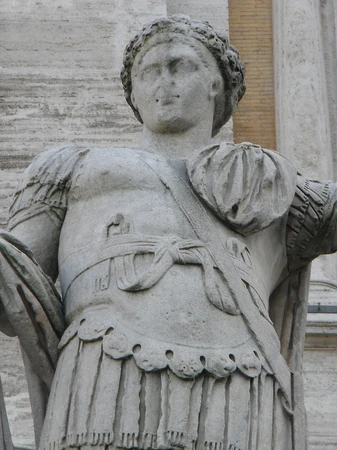
eight reigns CCCVI — CCCLXIV ADConstantine the Great reunited the empire by force, legalized Christianity by edict, moved the capital to a Greek fishing village renamed for himself, and founded the line that would rule for six decades. His sons split the empire three ways and then warred with each other. His nephew Julian, raised a Christian but schooled by Hellenist philosophers, attempted a last counter-revolution back to the old gods and died of a Persian spear in eighteen months. With Jovian, the line ended, and the army elected a Pannonian officer named Valentinian to begin again.



Valentinian Dynasty
four reigns CCCLXIV — CCCXCII ADSoldier-emperors from Pannonia. Valentinian held the Rhine for eleven years with grim efficiency and died in a rage shouting at Quadi ambassadors. His brother Valens was entrusted with the East and lost it at Adrianople in 378, the worst defeat Roman arms had suffered since Cannae, and the moment at which the Gothic presence inside the empire became permanent. Gratian, Valentinian's son, removed the altar of Victory from the Senate house, and was assassinated at Lyon. Valentinian II, a child when he acceded, was found hanged at twenty-one at Vienne. With him ended the dynasty, and the empire passed to a Spanish general whom Gratian had recalled from his olive groves in Hispania: Theodosius.

Theodosian Dynasty & the Fall of the West
thirteen reigns CCCLXXIX — CDLXXVI ADTheodosius the Great, the last emperor to rule both halves of the empire, made Nicene Christianity the state religion and split the empire permanently between his two sons when he died in Milan in 395. The Eastern half would survive for another thousand and fifty-eight years. The Western half had eighty. These are its last thirteen folios: from Honorius, the boy in Ravenna under whose reign the Goths sacked Rome for the first time in eight centuries, to Romulus Augustulus, the fourteen-year-old deposed by the Herulian chieftain Odoacer on the fourth of September, 476, and sent into peaceful retirement on a pension in Campania. He was the last. Here the Western chronicle ends.

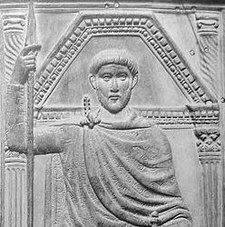
Here the Western chronicle ends. In the East, the empire continued unbroken at Constantinople for another thousand and fifty-eight years, until the afternoon of Tuesday, the twenty-ninth of May, 1453, when the walls of the Theodosian fortifications were breached and the last emperor, Constantine XI Palaiologos, disappeared fighting in the streets.